


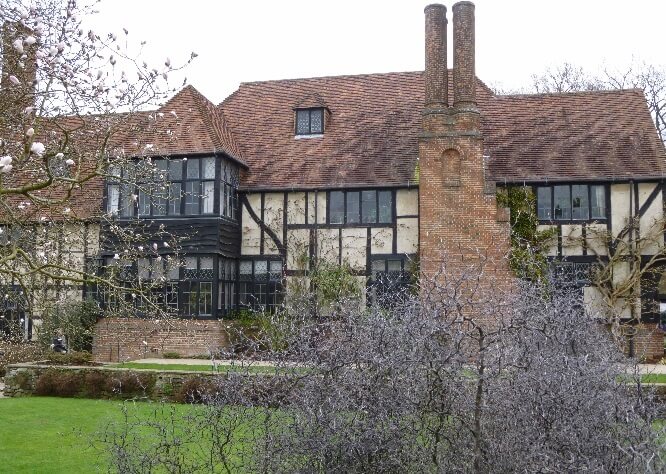
RHS Wisley gardens
nice quality time…
 Mr T2 and I spent a few enjoyable hours at RHS Wisley gardens in Surrey, England, on Easter Sunday this year. OK, perhaps it wasn’t quite Spring yet and you needed to like yellow a lot as daffodils were pretty much the only colour apart from green and brown. To be fair they work very hard to make it attractive all year round with a winter garden providing as much colour as possible, but there is only so much you can do with a wet weekend in April. Anyway, the first thing that struck me was how intrinsically accessible the gardens are, from a physical perspective. There are some rockeries and uneven ground that would be challenging if not impossible but most of the garden has been designed with wide pavements and open spaces, friendly for wheelchairs and pushchairs alike, with lots of seating for frequent stops for walkers.
  There is also a mobility bus (golf cart plus) and clearly marked stops at key points on the route.
  This included the glasshouse, which continues the theme of wide pavements and easy access to all levels within.
  (There is a large lift inside what is essentially a massive multi-storey greenhouse.)
  The landscape and buildings have clearly been designed with physical mobility in mind, and universal benefit.
accessibility everywhere?
What was less obvious to us, as bespectacled-but-sighted and with middle-aged but more-or-less fully-functioning hearing, was how well it might be accessible beyond physical mobility needs. We checked the accessibility information on the garden website, which gave useful information about hearing loops, guided tours and discounts for carers, and although this was all very helpful, the emphasis seemed to be on adapting facilities for accessibility by screening for additional needs at the start. Without the extra effort to accommodate in this respect any hazards beyond the gate remained – ponds for the visually impaired to fall into; silent electric vehicles to run over the deaf – to name but two. But as we tried to think of ways to exchange accessibility for inclusivity, the problem only seemed to get bigger, and more expensive, for a one-size-fits-all solution.
And perhaps therein lies the problem. We were trying to think of ways to make everything work for everyone, which might be the aim in an ideal (and new) world, but too big in a practical sense to deal with in one hit in the real world. Realistically we have legacy to deal with, on a massive scale. Listed properties are attractive to visit but a paradox for accessibility.
 Picturesque towns and villages are desirable because of the quaint and rickety buildings, narrow cobbled streets and lack of access for cars that didn’t exist when they were created, not in spite of these things. But there is a danger that if we dwell too much on the difficulties of transformation we could lose our way to making any progress at all. If we are to gain traction on change through continual improvement perhaps we should set to one side the too-difficult pile, at least partly, and put some unobstructed effort into the new things we can create that emphasise inclusivity by design.
new ideas came up
Continuing our stroll around RHS Wisley, with a bit more thought about the attraction’s natural affordances, we came up with the idea of a self-contained sensory garden. It could be designed with safety and accessibility in mind, but essentially everyone could enjoy the emphasis on a combination of all senses, identifying plants through smell and taste, as well as sight, and experiencing different textures and sounds. In this way, we are not trying to “fix” everything, but evolving the design by adding a new dimension, with an emphasis on diversity and inclusion. It could be a good approach to taking practical steps forward. Tracey Torble T2 Consulting April 2018